Paper Boy Race: Running game
- 4.6
- Rating
- 50.00M
- Installs
- Free
- Price
 Analysis by App-foxy
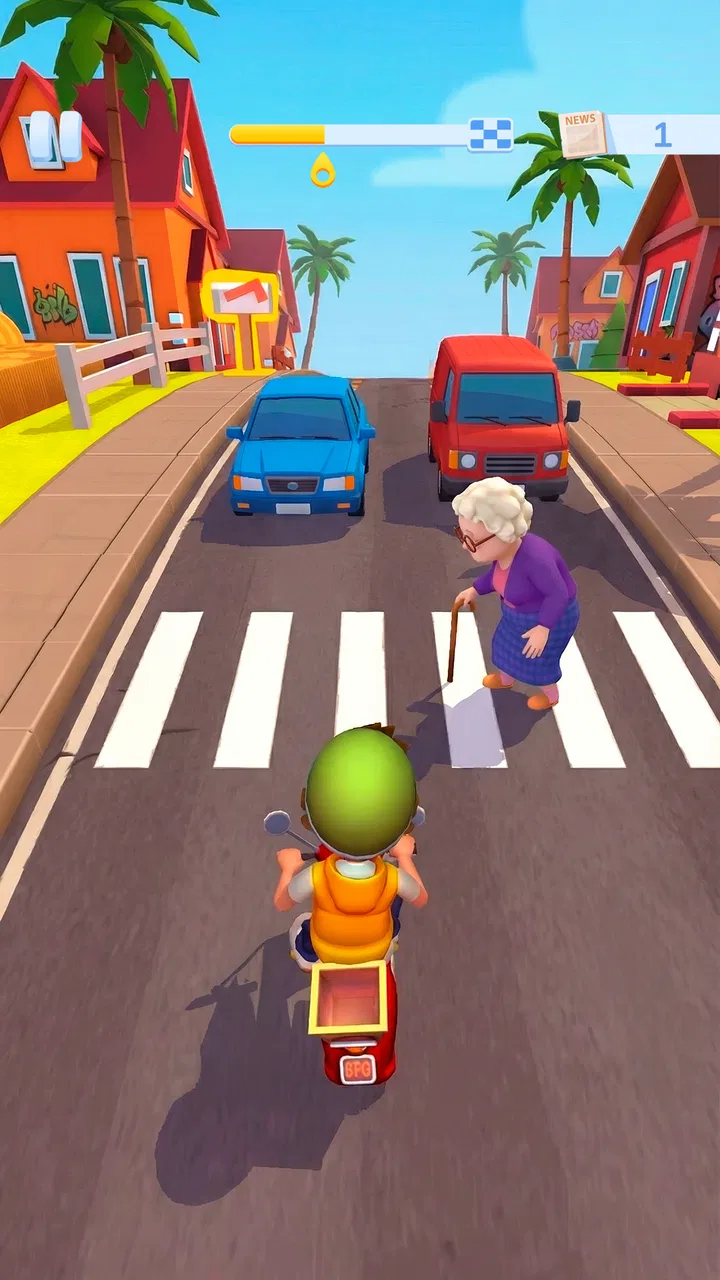
I went into Paper Boy Race expecting a quick arcade distraction, and that is exactly where it works best. It turns the familiar paper-delivery idea into a colorful motorcycle race, asking me to guide a paperboy through a three-dimensional course while trying to finish ahead. The concept is easy to understand within moments, but the appeal comes from how quickly a simple run can become a small test of timing, attention, and route choice.
Developed by Freeplay Inc, this free arcade game is aimed at players who enjoy short sessions rather than a long story or a complicated control system. Its Teen content rating gives it a slightly older audience label, while the broad Android compatibility starting with version 6.0 makes it accessible to many phones and tablets. The current version is 1.40.2, and its large audience—more than 50 million installs—suggests that the quick-race format has reached well beyond a niche group.
What I like most is that it does not ask me to learn a large rulebook before having fun. I can start, react to what is in front of me, and immediately understand whether my decisions helped or hurt the run. That makes it a natural choice for a spare minute, although players looking for deep customization, a substantial campaign, or a serious racing simulation should set their expectations differently.
You May Also Like

 Blood Strike: 2.5 Anniversary
Blood Strike’s Loadouts Turn Every Drop Into a Tactical Gamble
A close look at Blood Strike’s custom loadouts: how fast access to signature weapons reshapes its battle royale rhythm, rewards preparation, and narrows the gap between fights.

 Pandora - Music & Podcasts
Pandora’s Music Is Easy to Start, but Harder to Recover
Pandora’s strength is its low-effort path from a seed to a station. Its weak spot is how much confidence it asks you to place in connection, setup, and quiet recovery.

 8 Ball Pool
 Is Built on Rivalries, Rematches, and Routine
A close look at the rivalries, rematches, shared routines, and unanswered safety questions that turn a quick pool match into a persistent mobile community.

 Samsung Music
’s Quiet Strength Is Playing What You Already Own
Its reach comes less from spectacle than from dependable access to a personal library. That simplicity is both the app’s strongest retention engine and its ceiling.

 AccuWeather: Weather Radar
AccuWeather Review: A Quick, Clear Forecast for Everyday Decisions
For everyday plans, the best forecast is the one you can understand quickly. AccuWeather makes rain timing, radar, and local conditions easy to act on, with a few trade-offs.

 Hill Climb Racing
Why Hill Climb Racing Still Turns Crashes Into One More Run
A tiny car, a bumpy hill and one more upgrade: Hill Climb Racing keeps resurfacing because its simple chaos makes every near-miss feel personal.
More From Our News Desk



How the first races create clear goals
The opening appeal is built around a very direct objective: ride, deliver, and race as effectively as possible. The paperboy theme gives the action a recognizable identity, but the moment-to-moment focus remains on movement through the course. I never felt lost about what I was supposed to be doing. The best early goal is simply to complete a run cleanly, understand the rhythm of the track, and notice which actions make the finish easier.
That clarity matters on a phone. A complicated racing game can feel tiring when I only have a short break, but this one lets me concentrate on the next obstacle and the next opportunity. It is the kind of design that works while waiting for a coffee or taking a short break between tasks. I can play without committing to a long session, then put the phone down without feeling that I abandoned a complicated storyline.
The paper-delivery setting also gives the game more personality than an anonymous motorcycle racer. I am not just steering a generic vehicle around a track; I am working within a playful paperboy fantasy. That theme is not deep enough to replace a story-driven game, but it gives the races a clear visual and conceptual hook.
One useful habit I developed was treating the first attempt on a course as reconnaissance rather than a failure. Instead of immediately chasing the best possible result, I watched how the route developed and identified where my attention needed to be highest. This is a small but important shift: the game becomes less frustrating when I use an early run to learn the course instead of judging myself against an ideal result from the beginning.
The controls and goals are approachable enough for casual players, but that does not mean every run feels automatic. The challenge comes from maintaining awareness while moving through a three-dimensional environment. I had to avoid making decisions too late, especially when I was focused on the apparent reward ahead and neglected the next section of the route.
What progress feels like during ordinary play
The strongest progress signal is personal improvement. I notice when I reach a section more smoothly, react earlier, or finish with fewer mistakes than before. That kind of progress is especially suitable for an arcade title because it does not require a long explanation. A better run is immediately visible in how controlled it feels.
For me, the game’s pacing works best when I alternate between focused attempts and relaxed attempts. A focused run is about positioning and avoiding careless errors. A relaxed run lets me experiment with movement and learn what the course is asking from me. Switching between those two approaches prevents every attempt from feeling like a high-pressure examination.
Players who need constant rewards may find the progression less satisfying than in a large racing game with a detailed career structure. The attraction here is compact repetition: play, recognize a mistake, adjust, and try again. That loop can be rewarding, but only if the player enjoys improving through practice rather than needing a large stream of new content to stay interested.
I also found that the game benefits from short-term targets. Instead of thinking only about winning, I might focus on surviving a difficult section, keeping a better line, or reaching the finish without repeating the same error. These smaller goals make the experience feel more active and give each attempt a purpose even when the result is not ideal.
That is an important distinction for anyone deciding whether to install it. The game is not at its best when treated as a one-time novelty. Its value comes from the compact challenge of repeating a familiar type of race and gradually becoming more consistent. If that sounds enjoyable, the format has staying power. If repetition normally feels like grinding, the initial amusement may fade quickly.
Difficulty, mistakes, and the rhythm of a run
The difficulty curve feels more connected to player awareness than to a complicated technical system. Early attempts are about understanding movement and the shape of the race. Later attempts become more demanding because I know what is coming and start expecting myself to handle it better. That creates a natural pressure: once I have learned a section, a mistake there feels avoidable rather than mysterious.
This is where the arcade design succeeds. The game can be easy to pick up while still leaving room for improvement. I do not need racing experience to begin, but I do need patience if I want to perform consistently. The difference between a messy run and a controlled one often comes from reacting before the problem is directly in front of me.
My main criticism is that quick arcade games can make setbacks feel abrupt. When a run goes wrong near a section I already understand, the restart impulse is strong, but so is the possibility of frustration. The best way around that is to treat each attempt as information. I try to remember the exact moment where I lost control rather than blaming the whole course.
The three-dimensional presentation helps create that learning process because the route is not reduced to a flat line. I have to read depth and movement together, which gives the race more immediacy than a basic side-scrolling delivery game. At the same time, that perspective can make judging space less comfortable for players who prefer perfectly predictable lanes or a traditional top-down view.
For a younger or less experienced player, I would recommend starting with calm, observational play instead of aggressive movement. The paperboy theme may look lighthearted, but the race still rewards concentration. A player who rushes every decision can make the game feel harsher than it really is. Slowing down mentally, even when the character is moving quickly, made my attempts much more reliable.
What keeps the game installed—and what may push players away
The retention strength is the immediacy of another attempt. I can finish a race, recognize one thing I want to improve, and begin again without a long transition. That is a good fit for mobile habits, where play is often divided into small windows. The game does not need a large narrative cliffhanger to bring me back; the unfinished feeling comes from knowing I can do the next run more cleanly.
Its audience size reflects that accessible structure. The game holds an average rating of 4.6 from around 39 thousand ratings, which places it comfortably among well-received casual arcade experiences. I would not treat that figure as a guarantee that every player will enjoy it, but it matches my impression that the central idea is easy to approach and satisfying when its rhythm suits you.
There is also a useful social comparison built into the experience, even without turning the review into a contest of statistics. When I finish a run, I naturally think about whether the result felt efficient or clumsy. That self-comparison is enough to encourage another try. Players who enjoy chasing personal consistency will probably get more from the game than players who need a large multiplayer community or a detailed ranking system.
The main retention risk is repetition without enough personal investment. If the available race structure does not keep surprising you, the same short-session strength can become a weakness. I would not install this expecting the long-term variety of a full console-style racing game. Its purpose is narrower: offer a fast, readable arcade challenge with a distinctive paperboy wrapper.
Another practical point is age and tone. The Teen rating means parents should consider whether the game fits the preferences of the person using the device, rather than assuming that a playful delivery theme automatically makes it suitable for every child. The rating does not change the basic arcade appeal, but it is worth checking before handing the game to a younger player.
Because the game is free, it is easy to try without making it a major purchase decision. That makes it a sensible experiment for someone who likes motorcycle racing games but wants something lighter than a simulation. Still, free access does not automatically make it the right alternative to every racing title. A player who values realistic handling, tuning, or a deep vehicle roster will likely be better served elsewhere.
Small strategies that make each attempt more useful
My first practical tip is to separate route learning from performance chasing. On an unfamiliar run, I pay attention to where the course demands a decision and where I can safely concentrate on the next section. Once I know those points, I start refining movement. This prevents me from wasting several attempts repeating the same surprise.
Second, I try not to stare only at the immediate path. The three-dimensional view rewards looking slightly ahead, because late reactions are harder to correct. This is not a complicated technique, but it changes the feel of the race. I become less reactive and more deliberate, which is especially helpful when the course begins to feel faster than my attention can comfortably follow.
Third, I use short sessions deliberately. Playing for a few attempts, taking a break, and returning later can be more productive than forcing a long streak after several mistakes. Arcade games often make frustration look like determination, but my best runs usually came after I reset my attention rather than continuing automatically.
A fourth insight is to judge a run by control, not only by the final outcome. A result can be disappointing while still showing that I improved one difficult section. Keeping that distinction in mind makes the progression feel more tangible. It also helps explain why the game can be enjoyable without offering the broad progression layers found in larger racing games.
Finally, I would recommend using the game as a quick reflex break rather than as a substitute for a complete racing hobby. It fits neatly into a routine where I want a focused activity with an obvious beginning and end. It is less suitable when I want a long evening of exploration, customization, or narrative development.
How it compares with other arcade racing choices
Compared with a conventional motorcycle simulator, this game is much easier to approach. I do not need to understand realistic braking, detailed vehicle setup, or complex track strategy before enjoying a race. That simplicity is its advantage for casual use, but it also means experienced racing fans may find the handling and progression less demanding than they expect.
Compared with endless runners, the paperboy racing idea gives the action a stronger sense of a defined contest. I am not only trying to survive an endless stream of hazards; I am working through a race with a clear finish. That structure makes each attempt feel more complete, while endless-runner fans may miss the open-ended chase for a constantly rising score.
Compared with side-scrolling delivery games, the three-dimensional motorcycle presentation gives movement more depth and makes the race feel more immediate. The trade-off is that spatial judgment can be less straightforward. Players who prefer a flat, highly readable playfield may find a side view easier to master, while players who enjoy reading depth will probably appreciate the extra visual involvement here.
Those comparisons help define the right audience. I would recommend it to someone who wants a free arcade game with a playful premise, quick races, and a reason to retry after a mistake. I would steer away from it for anyone primarily seeking a realistic motorcycle experience, an extensive career, or a story that develops across many hours.
My verdict on the progression and long-term appeal
The progression works best as a test of improving execution, not as a promise of a huge career mode. Early goals are clear, the race format makes mistakes easy to understand, and the short attempts encourage immediate retries. The pacing is strongest when I treat each run as a small lesson and notice a specific improvement rather than expecting a constant flood of new systems.
Freeplay Inc has chosen a focused arcade identity, and I think that focus is both the game’s strength and its boundary. The paperboy theme makes the motorcycle races memorable, while the straightforward structure keeps them accessible. The cost of that accessibility is a lower ceiling for players who need elaborate progression or simulation-level depth.
With its 4.6 average, roughly 917 written reviews, and more than 50 million installs, it is clearly not an obscure experiment. Those figures make sense after spending time with it: the premise is instantly readable, the sessions are compact, and the retry loop is easy to understand. They do not remove the need to consider your own preferences, especially if repetition or a lighter progression model usually loses your attention.
I would install it when I wanted a quick motorcycle-themed arcade challenge that I could pick up without preparation. I would skip it when I was in the mood for realistic racing, extensive unlock management, or a long-form adventure. For the right player, Paper Boy Race is a pleasant little mobile racer whose best moments come from turning a chaotic first attempt into a cleaner, more confident run.
FAQs for Paper Boy Race: Running game
01What is Paper Boy Race: Running game about?
Paper Boy Race: Running game is an exciting endless runner where players take on the role of a newspaper delivery person racing through neighborhoods. The objective is to deliver as many newspapers as possible while avoiding obstacles and collecting power-ups. The game offers vibrant graphics, intuitive controls, and a nostalgic theme reminiscent of classic arcade games.
02Is Paper Boy Race: Running game free to play?
Yes, Paper Boy Race: Running game is free to download and play. However, it includes optional in-app purchases that allow players to buy additional power-ups, customize their character, or remove ads. These purchases are not necessary to enjoy the game but can enhance the overall experience.
03What devices is Paper Boy Race: Running game compatible with?
Paper Boy Race: Running game is available for both Android and iOS devices. It requires Android version 5.0 or later and iOS 11.0 or later. The game is optimized for smartphones and tablets, ensuring a smooth and engaging gameplay experience across various devices.
04Does Paper Boy Race: Running game require an internet connection?
No, Paper Boy Race: Running game can be played offline, making it perfect for on-the-go gaming. However, some features, such as leaderboards and in-app purchases, require an internet connection to function. Playing offline will not affect the core gameplay experience.
05How can I improve my performance in Paper Boy Race: Running game?
Improving performance in Paper Boy Race involves mastering the controls and timing your moves to avoid obstacles effectively. Collecting power-ups can provide temporary boosts, while practicing regularly will help you learn the best routes through the levels. Engaging with the community through leaderboards can also offer tips and strategies.
Pros
- Engaging and fast-paced gameplay.
- Intuitive controls enhance user experience.
- Vibrant graphics and fun animations.
- Regular updates with new features.
- Challenging levels for skilled players.
Cons
- In-app purchases can be pricey.
- Occasional ads disrupt gameplay.
- Battery consumption is high.
- Limited customization options.
- Needs a stable internet connection.

Paper Boy Race: Running game
Gallery